| Text |  | |
|
 |
|
| About Us - Sitemap - Feedback - Suggest a Site - Admin Access - Help |
|
 |
 |
 |
 |
|
|
|||||||||||||
|
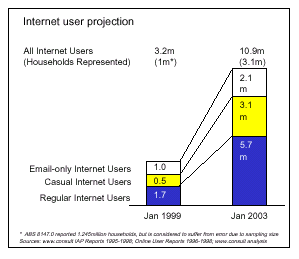
A Position Paper on Safe and Appropriate Internet Usage. EdNA Schools Advisory Group (1) Introduction The Internet is increasingly being used as a powerful learning force in Australian education. Teachers, parents and administrators are faced with the challenge of making the Internet a positive learning environment and a safe place for children and young people. The issue of child safety on the Internet has also been a concern for the general public and this concern is reflected nationally with the Broadcasting Services Amendment (Online Services) Act 1999 legislation, and internationally with a system of safe labelling of sites. The Australian school education sector response has been to educate children about safe use of the Internet, by the development of Internet management policies and by providing students with the means of accessing quality educational sites. Overview The Internet is a potent force for learning and communication and for improving the quality of teaching and learning. 43% of 9 to 14 year olds surveyed in the US, said that the Internet has improved their outlook about school. (2) In January 1999 there were 2.2 million Internet users in Australia. This is projected to quadruple by 2003 as shown in the graph below. Source: www.consult pty ltd (August 1999).
Research has shown that most parents and children seem to view the Internet as a positive new force in children’s lives. (3) Schools that are leading the way in applying new information and communications technologies are finding that the Internet enables student access to a vast array of information resources that includes primary source material, subject specialist sites, materials from cultural institutions and current news media. The Internet also provides a compelling communication tool that enables students to link with students from across the globe, engage in collaborative curriculum project tasks online and publish their own materials on the web. However the Internet has many aspects that differentiate it from other forms of media.
This leads to a level of anxiety within society, particularly by parents, that children will access material that is inappropriate. It is also feared that children may be exposed to danger by providing online information about themselves.
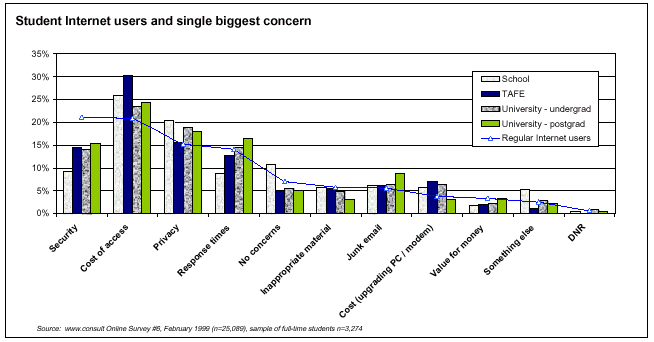
The prime concern for Australian families are security and privacy but both of these come after concerns about the cost of access and just before concerns about response times as shown in the above graph. Source: www.consult pty ltd (February, 1999). Broadcasting Services Amendment (Online Services) Act 1999 The Australian Federal Government has responded to these issues by the introduction of the Broadcasting Services Amendment (Online Services) Act 1999 (4), which has been designed to protect Australians from illegal and highly offensive material online. The Act aims to regulate Internet content and to help ease community fears. An online complaint hotline enables people to air their concerns about Internet content. The ABA has powers to issue notices to service providers aimed at preventing access to inappropriate materials. There is also the development of codes of practice by the Internet industry to improve information about the content of sites. Educating the community and encouraging the use of the Internet is also a focus. NetAlert (5) is a community advisory body on Internet content established by the Australian Government. Its role is an advisory one to educate parents about the Internet, advise young people on safe surfing and provide a link to the industry. Content labelling of sites The development of content labelling of sites in order to provide improved ways of managing access to Internet content is important to Australian school education. The Internet Content Rating Association was set up to self-regulate the World Wide Web and its Board has Australian education representation on it. (6) The RSACi system provides users of the Internet with information about the level of sex, nudity, violence and offensive language in Web sites. Its goal is to provide a rating system for web sites, which would protect not only children but also the rights of free speech of everyone who publishes on the World Wide Web. Filtering tools could then be used to access these rated sites that have been labelled as safe for children. The school education response Australian school education authorities have a major responsibility in teaching young people to use the Internet to enhance their learning. They also need to protect students from gaining access to undesirable material. Of increasing concern is the exposure of students to inappropriate communication through the Internet. Safeguards need to be in place to protect student privacy in the web-publishing environment and ensure student security. Systems and individual schools recognise their duty of care and the need to support the appropriate and safe use of the Internet. As one education department comments "schools providing student access to the Internet regard responsible use by students to be a significant issue and put in place education processes and behaviour management policies to deal with it." The response of education authorities is characterised by emphasising the positive benefits of the Internet in supporting student learning, helping students learn to use the new medium appropriately and with discrimination; and taking measures to protect students from illegal and offensive material. Education authorities also recognise that the definition of what is appropriate varies widely across school communities and that no one solution fits all. All education authorities emphasise that schools (in consultation with their parent communities) are best placed to make decisions about managing Internet access at the local level. Internet Access Management policies To support schools, all government education authorities have developed or are developing Internet Access Management policies. The Catholic sector has also developed guidelines at national and diocesan levels. The nature of the independent school sector in Australia is such that these schools operate without systemic direction. (See Appendix A) Characteristically, Internet Access Management policies include:
Some States and Territories have particularly strong devolution policies, providing only general guidelines and some technical options for school-based decision-making. Others mandate policies (for example by requiring schools to have acceptable use and non-disclosure policies, codes of practice and web publishing standards). A common practice is the publication on departmental websites of school exemplars of acceptable use policies and codes of practice. States and Territories also include Internet access management issues within their professional development programs for teachers and school leaders and teacher support materials and examples of best Internet learning practices. Quality sites All government and non-government education authorities emphasise the importance of access to high quality sites, evaluated by educators.
Increasingly, evidence from around the world suggests that a reliance on filtering software, caching and labeling alone will not reliably protect children from inappropriate Internet materials or behaviours and may have unanticipated outcomes by excluding sites of educational value. Schools need to ascertain what type of information is, and is not, being blocked by the use of filtering systems. Many of these programs ban access to perfectly innocent material as well as the inappropriate information they are designed to block The selection of some key words to exclude sites can eliminate information that may be very relevant to schools’ curriculum. The issues of freedom of speech and civil liberties have also been raised. (10) Schools have obligations to provide students with access to balanced information and it is important that one set of values and beliefs is not imposed. The approach of schools is to emphasise the positive aspects of the Internet for learning and to help children learn discrimination and appropriate Internet behaviours. At the same time schools are taking all necessary measures to prevent children in their care from being exposed to illegal and inappropriate materials or from losing their own privacy through their Internet activities. Conclusion There is no single approach to the issue of child safety on the Internet taken by Australian school education authorities. There is however general consensus on the issues and a pattern of responses emerging:
Schools need to have a comprehensive strategy in place incorporating educational and supervisory initiatives to support the appropriate and responsible use of the Internet by students. Students must be aware of the potential dangers of the Internet and develop appropriate strategies for dealing with inappropriate, offensive or illegal materials and practices, as is the case in any aspect of their lives. Schools play their part, in partnership with the home and community, in developing students' understanding of their rights and responsibilities and helping them to become good Internet citizens. Bibliography
Appendix A School Policy: Acceptable Use of Computer Facilities and External Networks www.decs.act.gov.au/policies/pdf/accucf.pdf Australian Capital Territory Education and Community Services information about acceptable use of the Internet. The Internet Help Files School Policy for Inappropriate Sites http://www.schools.nt.edu.au/olsu/aup.html N.T Department of Education advice for protective programs and hints for school policy concerning avoidance of student access to inappropriate sites. Internet User Guidelines http://www.nexus.edu.au/Publicat/Other_Publications/AUP.html Information from the South Australian Department of Education and Training that supports teachers, students and children using on line services as a resource to enhance teaching and learning. Privacy on the Net http://www.doe.tased.edu.au/0278/issue/984/privacy.htm Guidelines from the Tasmanian Department of Education for preserving the privacy of students on the Internet. Information Management Policies and Guidelines http://info.tased.edu.au/imb/irs/impolicy/index.htm#students The Tasmanian Department of Education has policies available on safe use of the Internet including Web Safety Policy and Filtering of Internet Material in Tasmanian Schools. Using the Internet - Taking Care on the Net http://www.sofweb.vic.edu.au/internet/takecare.htm Victorian Department of Education advice to schools and parents concerning child safety management on the Internet with a list of sites useful for developing acceptable use policies which best suit local conditions. Internet in the Curriculum http://www.eddept.wa.edu.au/centoff/cmis/eval/technology/usenet/use5.htm Western Australian Department of Education advice on use of the Internet including school management guidelines, access to the WA Internet Usage: Policy and Guidelines and other useful sites and references. Guidelines for the Use of the Internet http://www.ncec.catholic.edu.au/guidelines.htm National Catholic Education Commission guidelines for student and staff acceptable use of the Internet
EdNA Schools Advisory Group DATE 31 July 2000 |
|

Terms & Conditions | Privacy Statement Copyright © 2001 Education Network Commonwealth of Australia |
|